FitMe App Review: Are 10-Minute “Lazy Workouts” Really Effective? 💜
Finding enough time and motivation to exercise can be difficult, especially when traditional workout programs feel too demanding. FitMe – Lazy Workout at Home takes a different approach by offering short, accessible routines designed primarily for busy women, beginners, and people who prefer exercising at home.
But is FitMe genuinely helpful, or is the “lazy workout” concept simply clever marketing?
In this FitMe review, we explore the app’s workout styles, main features, advantages, limitations, pricing considerations, and overall user experience.

💡 What Is FitMe?
FitMe is a home-fitness application built around the idea that exercise does not always need to be long, exhausting or complicated.
Instead of asking users to complete hour-long gym sessions, the app focuses on short routines that can fit into a busy day. Many workouts are designed to take around 10 minutes and can be performed at home, beside a bed, against a wall or while using a chair.
The app includes programs targeting areas such as:
- Abs
- Arms
- Legs
- Chest
- Glutes
- Full body
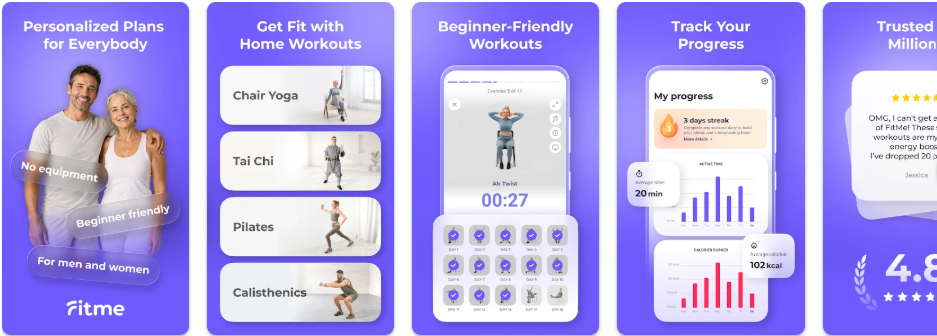
It also offers several low-barrier workout formats, including wall Pilates, chair yoga, in-bed exercises, strength training and general fat-burning workouts.
The central idea is simple:
Start with an exercise routine that feels manageable, build consistency and gradually make movement part of your daily life.
🏠 Main FitMe Features
1. Short Daily Workouts ⏱️
One of FitMe’s main selling points is its focus on short exercise sessions.
Many routines are promoted as taking approximately 10 minutes. This makes the app suitable for users who want to exercise:
- Before work
- During a lunch break
- Between meetings
- After waking up
- Before going to bed
A short workout will not automatically produce dramatic results, but it may be easier to repeat consistently than a demanding one-hour program.
2. Beginner-Friendly Exercise Formats 🌱
FitMe is marketed as a “lazy girl friendly” workout app. Although the phrase is playful, it represents a genuine product strategy: reducing the mental and physical barriers associated with starting a fitness routine.
Users can explore less intimidating formats such as:
- Chair workouts
- Chair yoga
- Wall Pilates
- Bed exercises
- Low-impact home workouts
- Basic strength routines
These options may be helpful for beginners or people returning to exercise after a long break.
However, users with injuries, mobility restrictions or chronic medical conditions should not assume that every routine is automatically suitable for them. Exercise selection should be based on individual ability and, where appropriate, professional medical advice.
3. No-Equipment Home Workouts 🏡
Most FitMe routines are designed to be completed without gym machines, dumbbells or expensive accessories.
Depending on the selected program, users may only need:
- A chair
- A wall
- A bed or exercise mat
- Enough space to move safely
This makes the app more accessible for people who do not want to join a gym or purchase fitness equipment.
4. Multiple Workout Styles 🧘♀️
FitMe does not focus on only one training method. Its store listings mention a combination of yoga, wall Pilates, chair exercises, strength training and fat-burning routines.
This variety is useful because different users may prefer different levels of intensity.
| Workout style | Possible appeal |
| Wall Pilates | Controlled, Pilates-inspired movements using a wall |
| Chair workouts | Accessible exercises with seated or supported positions |
| In-bed workouts | Gentle movement with a very low starting barrier |
| Yoga | Flexibility, balance and controlled movement |
| Strength workouts | Muscle-focused bodyweight exercises |
| Fat-burning routines | More active, faster-paced sessions |
FitMe’s variety may also reduce boredom for users who dislike repeating the same type of workout every day.
5. Targeted Body-Area Programs 🎯
Users can choose routines that focus on specific areas such as the stomach, legs, arms or glutes.
These programs can help structure a workout schedule, but it is important to maintain realistic expectations. Exercising a particular body part can strengthen and develop the muscles in that area, but the body does not necessarily lose fat from only the area being exercised.
For sustainable fitness progress, targeted workouts are generally more useful when combined with full-body movement, recovery, consistent activity and balanced nutrition.
6. Goals, Progress and Reminders 🔔
FitMe uses goals and reminders to encourage users to return to the app regularly.
This may be one of its most valuable features. For beginners, the biggest challenge is often not finding an exercise—it is performing that exercise consistently.
Daily reminders and visible progress can create a simple habit loop:
REMINDER → SHORT WORKOUT → COMPLETION → PROGRESS → REPEATThe shorter the routine feels, the easier it may be to begin.
👩 Who Is the FitMe App Best For?
FitMe may be a good match for:
Busy women
The short sessions are easier to fit around work, childcare, household responsibilities or a busy social schedule.
Complete beginners
The app offers workout formats that may feel less intimidating than traditional gym programs.
People who prefer privacy
Every routine can be completed at home without exercising in front of other people.
Users who struggle with motivation
A 10-minute workout may feel psychologically easier to start than a long session.
People interested in wall Pilates or chair workouts
The app combines popular home-fitness formats inside one platform.
Users returning to exercise
The variety of lower-barrier routines may provide a manageable starting point after a period of inactivity.
⚖️ FitMe Pros and Cons
✅ Advantages
Short and manageable sessions
The approximately 10-minute format can make daily exercise feel more achievable.
Multiple workout categories
Users can explore wall Pilates, yoga, chair workouts, bed exercises and strength routines.
No gym membership required
Most sessions can be performed at home with little or no equipment.
Suitable for busy schedules
The app is designed around convenience rather than long training sessions.
Body-area targeting
Users can choose routines based on their preferred focus areas.
Available on Android and iOS
Users can complete a FitMe app download through either Google Play or Apple’s App Store.
❌ Possible Disadvantages
A subscription may be required
The app is free to install, but some content and programs are offered through in-app purchases. Users should carefully review the subscription price, billing period, renewal conditions and cancellation process before confirming a purchase.
Not every routine will suit every physical condition
Some users may need alternatives for knee, wrist, hip or back discomfort. A Google Play reviewer praised the gradual difficulty increase but felt that the program did not provide enough accommodation for several joint-related limitations.
Personalization may feel limited
The onboarding process may create a customized-looking plan, but users seeking detailed coaching based on injuries, movement assessments or performance data may find the experience less individualized than working with a human trainer.
Progress transfer may be a concern
In a response to an App Store review, the developer stated that device-to-device progress syncing was not available at that time. Users planning to change devices should verify whether this limitation has since been resolved.
Short workouts have limits
Ten-minute sessions can support consistency and daily movement, but users pursuing major strength, endurance or athletic-performance goals may eventually need longer or more progressive training.
⭐ FitMe Ratings and User Feedback
As of August 2026, the Google Play listing shows a rating of approximately 4.5 stars, more than 500,000 downloads, and tens of thousands of reviews. The US App Store listing displays approximately 4.8 out of 5 from around 76,000 ratings. Store ratings and totals can change over time.
Positive feedback commonly relates to:
- Convenient workout duration
- Gradual increases in difficulty
- Accessible home-exercise formats
- Programs that help users establish consistency
- Visible progress after regular participation
Critical feedback has mentioned:
- Subscription and cancellation confusion
- Limited exercise modifications
- Audio or video presentation issues
- Difficulties restoring purchases or progress
- Programs feeling less personalized than expected
The overall ratings are strong, but prospective users should consider both the workout experience and the subscription terms before purchasing.
💳 Is FitMe Free?
FitMe is free to install on supported devices, but it includes in-app purchases.
This usually means users can download and open the application without paying immediately, while full programs, premium plans or extended access may require a subscription.
Before subscribing, check the payment screen for:
✓ Exact subscription price
✓ Weekly, monthly or annual billing period
✓ Length of any free trial
✓ Automatic renewal date
✓ Cancellation instructions
✓ Refund eligibility
Never rely only on an advertisement or introductory page. The confirmation screen in Google Play or the App Store should show the actual amount that will be charged.
🔥 Top 5 Fitness Apps Right Now 🔥
We’ve ranked the top 5 apps of 2026.